Showing posts with label PC Engine. Show all posts

Sunday, May 10, 2026

Space Invaders - Fukkatsu No Hi (PC Engine)

Vertical fixed
Checkpoints OFF
1 Difficulty level
7 Stages
Ship speed fixed
- - - - - - -
Developed by Taito
Published by Taito in 1990


The days of glory of Space Invaders are long gone. By that I mean the craze that hit arcades in their infancy so that people could compete and repel those slowly-descending aliens in a static screen, as well as the alleged shortage of coins in Japan, for example. The original formula is now old and decrepit, and the slightest idea of having to submit myself to it bores me to the bone. During the 16-bit era, however, Taito fortunately started to expand the old recipe into something more dynamic, with a different sort of challenge that not only felt fresh and challenging but also allowed players to end the invaders' offensive for good.

Space Invaders - Fukkatsu no Hi for the PC Engine is far more than a simple port of Taito’s legendary arcade hit. It stands as a definitive tribute to the game that sparked the global shoot 'em up craze, but it also offers a unique package that unites two games in one. The title translates to "Day of Resurrection" and bridges the gap between eras by featuring a pixel-perfect rendition of the 1978 original alongside a revamped "Plus" mode. Plus mode comprises seven stages of fixed vertical shooting divided in 25 waves, and that's where the meat covers the bone here. It's the sole reason why most people would even approach the game in the first place, myself included.

From the main screen, if you go the left option you'll play a somewhat faithful rendition of the original game, so no surprises there. If you go to the right option then you'll have access to the "Plus version", which kickstarts a neat intro with your ship departing to battle with a display of polygons. The pre-screen prior to each level shows the name of the stage, the number of the starting wave (it's always 1 if you don't continue) and the number of continues left. For single-credit attempts at the game these numbers are moot, but you do get two extra continues as each stage is beaten.

An honest credit in the "Plus Version" mode of Space Invaders - Fukkatsu No Hi
(courtesy of YouTube user The VideoGames Museum)

By shooting down the invader lines they will slowly move faster, to the point where the last remaining alien will move really fast, requiring the player to exercise good aiming. If this last invader touches the surface the credit will end right there regardless of remaining lives left. There's no way to upgrade your firepower, which is limited to a single shot at any given time. The good news is that these shots can block every single enemy fire, normal bullets and lasers alike. Every now and then a flying saucer will cruise the top of the screen, carrying items to make your life easier.

But there's a catch with the saucers. You need to hit them at their exact center, otherwise they won't drop anything. Hitting the tips will only result in points, but no goodies. That's okay in the early levels, but later on things get so difficult that you definitely need to rely on whatever the game might give you. The assortment of items includes:
  • Life recovery (RECOVER-S): adds 2 extra lives (note: an extra life is also granted after stage completion). 
  • Homing beam (H-BEAM): single shots that always target the closest alien in the enemy armada.
  • Buster Laser 1 (BL1): straight laser that obliterates a complete vertical line of invaders.
  • Buster Laser 2 (BL2): movable straight laser that can be displaced left or fight (if used with directionals) or fired straight like BL1 (without using directionals). 
  • Hyper Laser (H-L): two thick blue shots that obliterates a complete horizontal line of invaders.
  • Hyper Shield (H.SHIELD): temporary invincibility.
  • Fire Flower Laser (FFL): a laser shower that explodes on the top the screen and falls down to the sides.
  • Super Inazuma Attack (S.I.A.) - a small number of powerful shots that can destroy up to three vertical lines of invaders.
  • Time stop (T-STOP) - freezes all invader movement and shots for a brief while.
Don't be fooled by the game's friendly pace in the beginning. The difficulty slope is remarkable, with invaders quickly increasing aggression with faster shots and diagonal attacks. The game has a random nature to stage layouts, with varying formation types and backgrounds. Some of them have fixed obstacles that block your firepower, but two variants are particularly aggravating: the one that unfolds in near darkness (as if you had a narrow flashlight above the ship) and the stage with two sets of asymmetrical invaders that travel only half the screen to descend. Sometimes the latter does not appear at all, but on the other hand you might come accross two dark stages in the same run.

The very satisfying effect of the Fire Flower Laser

Fukkatsu No Hi's initial three stages have 3 waves each, but all subsequent levels come with 4 waves. Overcoming the odds to reach the end is no joke though. The game is a tad harder than sibling Space Invaders '91 on the Mega Drive, and requires not only a good degree of reflex and aiming skills but also a deep knowledge of how items work. They disappear really fast, and knowing what each one does is not as intuitive as you might think. The invincibility shield, for example, is the best single item you might get, so there are times where it's just better to avoid the others – unless it's the extra lives when you're down in your reserve (it's not possible to have more than 9 lives in stock). Buster Laser 2 is tricky to use, and often leads to terrible mistakes if you don't pay attention to directionals. Important: any new item taken overrides the effect of the previous one, and any active item is carried over between waves in the same stage only. 

A turbo controller is also definitely recommended if you want to get serious with this game. There is a trick to get autofire but it didn' work all the time with me (button I + RUN at the start screen). Aside from that, general tips to any Space Invaders game still apply of course. When destroying the last invader, always be close to the side that favors your strategy, which is often the side to where the alien armada moves first. Your ship is rather slow, after all. And it might be just my overall dexterity waning with age, but I always preferred to start any level on the right side. Alas!  

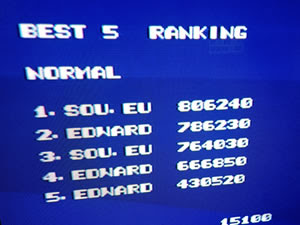
Once finally acquainted with everything, I kept hammering the game for a few days until my strategies clicked with the 1CC result below. As I mentioned above, Fukkatsu No Hi is on par with Space Invaders '91 in terms of fun, but it's definitely a tougher challenge. The soundtrack isn't endowed with the rocking punch of the Mega Drive game but is decent enough. In the end, my opinion is that both should be experienced together for a maximized 16-bit invader fix. Don't bother going to the Super Nintendo version, it's based on Space Invaders DX and does not offer anything more than the old trivial endless drag.   


Wednesday, October 30, 2024

Terra Cresta II (PC Engine)

Vertical
Checkpoints OFF
1 Difficulty level
6 Stages
Ship speed selectable
- - - - - - -
Developed by Nichibutsu
Published by Nichibutsu in 1992


Despite what some would normally believe, the Cresta series didn't evolve or was planned by Nichibutsu as a regular game franchise would. After Terra Force and UFO Robo Dangar failed to continue the arcade legacy left behind by Terra Cresta, the company decided to get back to the drawing board and launched Terra Cresta II exclusively in Japan for the PC Engine. The game tries to live up to the expectations of a sequel made for the home market, bulding upon the ideas of the original to deliver a shooting romp that in many aspects resembles similar outings in NEC's home platform, such as those relesead in the Soldier series.

Terra Cresta II starts out in a very stylish manner, with the Wing Galiber II ship departing in a nifty takeoff towards its first mission over ocean and land. Basic inputs still use two buttons, with shot mapped to button II and formation activation mapped to button I. Duly inherited from the original game, this formation mechanic will always be possible provided you have taken at least one extra ship part released by destroying flying carriers. These carriers are numbered from 2 to 5, corresponding to two enhancements to the frontal shot (one of them with piercing capability), a two-way upgrade that makes you shoot backwards and a rear barrier that can block bullets and destroy enemies upon contact.

A formation attack separates all ship parts into a wider pattern, greatly enhancing your shot coverage for about 10 seconds before returning them to their original state. It uses one F of your formation stock, which is filled up to three again whenever another ship part is collected. In addition to that, immediately after combining all four ship parts, the Wing Galiber transforms into an invincible phoenix/firebird for 10 seconds.

Insects over crimson ravines

The gameplay described so far is exactly the same of first chapter Terra Cresta. However, as you venture across several backgrounds and defeat a series of mid- and main bosses to advance, you'll notice that the game actually has a lot of nuances that might even make you confused as to how they work. The first example is the F item, that comes in two variations that are almost exactly the same. The regular F increases your formation stock by 1, whereas the flashing F determines that your next formation attack will be special: it sends out lots of extremely effective homing phoenixes. If the formation stock is full (3), collecting a normal F gives you 10.000 points, and a flashing F triggers the PRB "Phoenix Rolling Bomber", which targets everything on screen with a neat effect of multiple swirling phoenixes.

There are also a few more features and details that justify why the Wing Galibur II is such an improvement over the original design from Terra Cresta. The most obvious one is the selection between four speeds at the press of the SELECT button. And in a complimentary design nod to competitor company Compile, Nichibutsu also endowed the ship with brief invincibility windows when either entering or leaving a formation attack, as well as a 1-hit shield upon getting hit with at least one ship part when not in formation. If that happens the ship gets stripped down to its default condition. However, if the bare ship gets hit during a formation attack you're killed immediately.

Another interesting detail in the gameplay is that upon dying you can still recover ship parts if they drift away after the explosion. It doesn't happen all the time, so it's nice to be prepared to do so when it does. Finally, capsule parts that spread apart when you destroy an item carrier are capable of hitting and destroying enemies in their path. Each destroyed enemy will be worth 10.000 points, so good timing can net a great deal of points from this. And amassing points is the main source of resources in any given credit, after all an extra life is achieved at every 200.000 points you're able to score.

As we can see, there's a little more than meets the eye in Terra Cresta II. One thing is certain: on top of granting many extra lives, the game tends to make you feel very powerful whenever you're abusing formation attacks to overcome the odds. Don't get too confident though. Dying can be a huge blow in your ability to handle enemies, leaving you underpowered in the worst possible situations. Significant slowdown starts to happen as enemies pile up, and facing some of the bosses with the pea shooter can be really annoying because it severely affects the pace of the game. The second boss, in particular, is already a major flow disruptor. And if you get to him with a bare ship it gets even worse.

Tinkering with formation arrangements and facing the first level of Terra Cresta II
(courtesy of YouTube user ShiryuGL)

Unfortunately, pacing is actually the main problem with Terra Cresta II. Flames and volcanoes, castles, evil plants, ice mazes, Egyptian sandy areas and sky scrambles set the tone during the first five stages of the game (see the influence from Namco's Dragon Spirit there?). Once the game enters the sixth stage things start to fall apart, with an extremely long level that makes you fight all previous bosses again in between regular enemy sections. The time slip to Terra Cresta, which makes you play a full loop of the first chapter before entering the area for the final boss, is quite nice but it's not enough to bring the game up to speed again. The whole sixth stage is actually the last one and represents half the game's duration!

The size and the multiple phases of the last boss give some dignity to the final battle, as well as the relatively decent soundtrack. However, something's definitely off when half a game that lasts over an hour feels like a rehash of its own assets. In essence, what starts out as a promising adventure with clear gameplay improvements comes to an end in a rather lower note.

Terra Cresta II had the potential to be great, but Nichibutsu ditched it in the end. It's still a fairly acceptable diversion though since it does nothing wrong except being too long and incurring in too much repetition. For those who fancy caravan modes, the HuCard also includes 2-minute and 5-minute modes, each with its own high score buffer. Note that when playing a normal game you need to perform a soft reset (RUN + SELECT) once the ending credits halt at the final screen and then go to "Score" from the main menu in order to see the high scores. My best 1CC result is below, using the default formation patterns. In a feature inherited from the NES port of Terra Cresta, the game allows players to change the formation patterns before starting the credit.
 
 
The next chapter in this series is Terra Cresta 3D, released for the Sega Saturn in 1997.

Monday, September 30, 2024

Detana!! TwinBee (PC Engine)

Vertical
Checkpoints OFF
4 Difficulty levels
6 Stages (loopable)
Ship speed by icons
- - - - - - -
Developed by Konami
Published by Konami in 1992


The only home port of the chapter that redefined the series into a full blown cute'em up franchise, Detana!! TwinBee brings to the PC Engine the multitude of colors of the arcade game while toning down the difficulty for the most part. My statement above stems from the fact that Detana!! is actually the first arcade sequel to the original TwinBee, after several intermediate entries for the NES and the Game Boy. Although the previous games did have some cute elements, they were hardly set in stone as to their overall tone. That's why I believe Detana!! to be the start of the second and better phase of the franchise as a whole.

Living up to its alternate title Bells & Whistles, the game continues to build upon the colored bell mechanics to provide a very specific kind of shmup rush, which mixes survival and scoring against a backbone defined by dynamic difficulty. Even though the punishment for dying is still remarkable, especially in the final levels, it's certainly a more easygoing and approachable experience than the arcade original for a series or reasons. Reduced hitbox and bullet count, less fierce rank progression and extra lives (1UPs) to be collected from specific ground targets are some of them.

The only real compromise besides the expected graphical and musical downgrade is the absence of the sixth level of the arcade original, the one that takes place in the desert landscape. Other than that, everything about the gameplay is duly preserved and remains the same.

Japanese rooftops protruding above fluffy clouds in stage 5
 
Basic inputs are very simple and work with shot in button II and bomb drop in button I. Just like in Xevious, bomb drops are used to hit ground targets. By holding shot you can charge and release a powerful attack that pierces everything and inflicts damage. Powering up is mainly achieved by hitting bells released from clouds and taking the colored ones. At every five hits the bell changes color to a different one other than yellow, in an ongoing sequence with the following order: white (twin shot), blue (speed-up), green (trailing options), red (shield barrier), purple ("solidifies" your options, making them able to cancel bullets and deal aerial damage), black (speed-down) and back to white. You can't have red and purple simultaneously, and if you already have a particular item the corresponding bell in the sequence will be yellow.

The secret to a better chance of survival is to use the first batch of clouds in the very first level to power up as fast as you can. At least two speed-ups are needed, as well as twin shot and options. Extra upgrades can be applied by collecting the ground bell, which gives you a three-way shot for the main character, and by releasing and "docking" with GwinBee, the third mecha besides TwinBee (player 1, piloted by Light the boy) and WinBee (player 2, piloted by Pastel the girl). Firepower is increased when united with GwinBee, especially the charge shot. The only downside is that the hitbox increases twofold, and GwinBee will be lost if hit.

A final detail about the hitbox is that you can lose one or both arms of the character, thus affecting its ability to drop bombs. If both arms are lost an ambulance item will cruise the screen for you to repair them, but note that this only happens once in each level. If the arms are once again lost you'll be unable to drop bombs until you die or reach the next level.

Speaking of scoring, the formula is rather simple. Just collect successive yellow bells. Once the initial ones are taken (four), all others will be worth 10.000 points provided you don't let any of them fall down the screen. Juggling bells for points can be tricky if you're not fast enough, particularly in the second half of the game since enemies start coming down more aggressively and in greater numbers. Finally, you also get extra score by collecting fruit released from ground targets, and 1.000 points are awarded for most of the aerial enemy waves you're able to completely wipe out. 

Intro and first stage of Detana!! TwinBee on the PC Engine
(courtesy of YouTube user The VideoGames Museum)

It's no secret I was never much of a fan of the concept behind the TwinBee series. However, amidst forests, skies, rivers, mountains and ravines, there's no denying that the action in this version of Detana!! TwinBee is finely tailored to the console format both in terms of fun and difficulty. There's just one glaring exception: the final boss. For some odd reason, that creature is even harder than its arcade counterpart no matter the rank situation when you get to him. No only does he spit a lot more bullets, but he also takes a longer beating to finally go down. This crazy difficulty spike is definitely unexpected and uncalled for, and sort of taints the general appreciation of the game.

Regardless of the above, one of the nicest aspects of the PC Engine port of Detana!! TwinBee is that it allows co-op play, a feature that's often well regarded in console adaptations. I admit the game might have a different kind of charm when played with a friend, as long as both players are able to come to grips with the inherent greed associated with bell manipulation.

I played with Light/Twinbee (player 1 side) in the Normal difficulty and reached stage 2-1 with the final score below. The second loop is a lot harder than the first, and unless you have some proper practice chances are the adventure will come to an end right there and then.


The next title in the series is another console game, the amazing Pop'n TwinBee for the Super Famicom, which was later followed by the final arcade chapter TwinBee Yahho!.

Friday, August 9, 2024

Metal Stoker (PC Engine)

Arena
Checkpoints OFF
3 Difficulty levels
7 Stages
Ship speed fixed
- - - - - - -
Developed by Face
Published by Face in 1991


When done right, unscrolling arena shooters do have the potential to be engaging experiences. We've come a long way since T.A.N.K. and Commando, some of the most recognizable forefathers of this particular branch in the shooting genre. The glut of cheap imitations that followed and are still being made to this day unfortunately diluted and eventually killed the appeal of these types of video games. They're either too generic or too cluttered with influences from other genres, especially the ones of the pedestrian type. At least from my limited perspective, military tank-based games fare a little better though.

For home consoles Metal Stoker is a clear example of an honest and decent take in this subgenre. It's not outstanding in any way and it doesn't come off as crisp or energetic as Mega Drive's Granada, which came out a year earlier, but gets the job done and delivers a good level of variety in the stage design. It's also possible to glimpse both in the graphics and in the soundtrack some of the creative spark seen in Hani in the Sky, the only other shmup made/published by developer Face for the PC Engine. In my opinion the background music for stages 3 and 4 are definitely standouts. And just like the game of the flying haniwa, Metal Stoker is yet another example of a shmup that has no scoring system.

Without scoring and the consequent push for a killing spree and without any sort of timer to put pressure on players, this game is perfect for those who prefer to move about carefully and at their own pace, be it in tight maze-like environments or in open space areas.

Meet the boss of stage 6

Players take the role of a female pilot immersed in simulation combat across several areas connected together in individual stages. In each of these areas you must guide a tank and destroy a particular set of enemies to proceed, from simple static generators to specific enemy flocks or a series of mid-sized captains and bosses. It's nothing complicated, except for a few sections where you must navigate through corridors with fast moving drones or find your way out of an energy barrier maze. Shooting is accomplished with button II, whereas with button I you lock/unlock the shooting direction of the tank. By pausing it's possible to choose one of the five weapons available (once they're firstly acquired), and by pressing SELECT you trigger a special attack that consumes one power level of the weapon that's being currently used.

Each life comes with four energy/shield units shown at the top right corner of the screen. With every hit the energy goes from green to yellow, red, blinking red and then a life is lost (fortunately with no downgrade to the firepower). Item containers are scattered around the stages and reveal either energy/shield refills or power-ups for any of the five weapons in the game. Besides the default vulcan shot there's also laser, mines, sonic barrier and homing missile. All of them except for the vulcan need to be activated with the first power-up before being available for selection with the START button. Then all further power-ups upgrade the weapons individually up to five power levels.

It goes without saying, but handling the resources in Metal Stoker is easily done by avoiding to take damage. However, this is even more important for the extend mechanics because if you take an energy refill item with a full energy gauge (green) you'll get an extra life instead. Extra lives are also granted after completing stages 3 and 6, whereas the energy meter is fully refilled whenever a new stage begins. Apart from that, memorization is important in order to not get lost in the action during those levels with a large number of targets found through warp gateways. The number of mirrored sections is a bit excessive but in the end I guess it helps to understand the flow of the game faster. Most of the time indicating arrows show where you need to go, often accompanied by scratchy voice fragments that remind you of the early voices from Mega Drive games.

Your assignment begins now
(courtesy of YouTube user The VideoGames Museum)

While I did get through Metal Stoker without recurring to special attacks, the ones related to the mine dropper and the sonic barrier are actually quite useful, unlike the weapons themselves which are pretty much useless. The special attack for the mines make you hover in place so that you can avoid enemy fire and pummel away whatever lies below. As for the sonic barrier, it makes the tank invincible for a good while, hence allowing you to ram into enemies and make them have a taste of their own medicine. More than the 4-hit shield special of the vulcan, they're certainly a great way to deal with bosses that tend to corner you.

All in all, the joy of playing Metal Stoker might be a feeble one, but the game is a valid diversion within the shmup library of the PC Engine. It's just a pity that players don't have any sort of metrics to measure their mighty performances. However, should you fancy a tougher challenge there's always the possibility of getting access to a hidden menu with a special code that allows you to change the default difficulty: during the start screen with the buzzing effect press I, I, II, II, ←, →, ↑, ↓ and SELECT four times, then press I + II at the same time.

For posterity, below is a photo of the moment of revelation in the game's story. During the end credits you get to know that you were not in a simulation environment after all. It was all real, as is our neverending thirst for more shmupping adventures, which I must now quench by moving on to my next assignment. Cheers!
 

Tuesday, March 21, 2023

Magical Chase (PC Engine)

Horizontal
Checkpoints OFF
3 Difficulty levels
6 Stages
Ship speed by icons
- - - - - - -
Developed by Quest
Published by Palsoft in 1991


Sometimes video games are so aptly named that almost everything you need to know about them is already in the title. Magical Chase is exactly what its name implies, for example. It’s a chase, and it’s magical. It’s also about a little witch flying on a broom, which is of course the most important design aspect of the game and mirrors the setting of a much more famous shooter featuring another witch named Cotton. Since the witch in Magical Chase is named Ripple, wouldn’t it have been a wise move for the developer to also release the game as Ripple? We could’ve have another similarly long and successful franchise then.

Jokes aside, even though no sequel was ever developed for Magical Chase the game at least got a port for the Turbografx-16 that holds the distinction of being one of the rarest titles for NEC’s console in the West. No differences exist in the core gameplay between both versions, but the Turbografx-16 port translates all Japanese texts and applies a few visual tweaks to character sprites while repainting the whole first level with a new medieval setting. Either way players are bound to experience a charming shooting romp with neat graphics, nice music and great variety from beginning to end. It doesn't take long to see the game's got plenty of personality without sounding too derivative, on top of exhibiting great parallax effects with absolutely no slowdown.

A brief snippet of the first stage of the Japanese PC Engine version
(courtesy of YouTube user Arcade Forever)

Cute little witch Ripple accidentally released six devilish creatures from a forbidden book, and off she goes to undo this with the aid of two star friends/maidens. There’s a total of six levels to go through with increasingly higher survival stakes as you fight mechanized enemies, enchanted forest demons, a huge flying fortress, evil snowmen with hockey masks, a dreadful floating knight and a slew of powerful wizards and other strange beings. Ripple is capable of firing magical shots with button II, as well as have her star options locked in place or freed with a press of button I. A secondary and very important resource consists in pressing buttons I and II at the same time, which then fixes the direction of the bullets they fire. Just do it again to unlock shot direction.

Since the stars can fully block most enemy fire (exceptions are lasers and large ball-shaped projectiles), learning how to use them properly is extremely important in the long run. For every credit you get a health bar with 8 hearts and 6 slots for magic spells. The leftmost spell is used whenever you double tap button II (this is why you can't activate any turbo fire in Magical Chase), and if the hearts in the health gauge deplete the game is over. Health can be recovered by taking the candy lollipop (1 heart) or the cake (2 hearts), which are always left behind by killing specific enemies. Hearts can also be refilled by purchasing the necessary items from the shop that appears at certain points throughout the stage.

Shop purchases use the stock of crystals you're able to collect from every destroyed enemy or as a special bonus at the end of the level. Getting familiar with each item in the shop is important to devise an upgrade/recovery strategy, however the first and most important purchase is definitely maximum speed. Then you're set to experiment with all other items. The gallery of more powerful weapons includes 3-way, wave, staggering, bubble, homing, reflective and piercing shots. While there are no upgrades to these weapons, two specific improvements can also be applied to the behavior of the star maidens (cracker ball and cyclone), thus increasing Ripple's overall firepower. Magic spells consist of heart (recovers 2 hearts), bomb (screen-clearing blast) and × (stars turn green and also inflict damage for 15 seconds). Finally, the medicine completely refills the health gauge, the elixir gives you a full new health bar when the current one is gone and the fruit of life expands the health gauge by one heart.

Certainly not Super Mario Bros pipes!

At first Magical Chase doesn't impose any sort of pressure on the player. There's no damage incurred in touching the terrain, but you can still get scroll-crushed by objects and walls. The difficulty slope is relatively steady, nevertheless the bulk of the challenge is reserved for the last couple of stages. Some boss attacks can drain two and a half hearts, quickly leading to a horrible death if you don't have a good reserve of recovery spells to get back up during the battle. Every stage has a boss and one or more mid-bosses, and some of the later ones are quite demanding in terms of dodging. An interesting detail here is that it's not the main boss that gets quickly glimpsed at the start of every level, it's the mid-boss.

What makes Magical Chase an approachable game for everyone is the shop, definitely a lifesaver for the toughest sections mentioned above. Some of the items increase in value after a few purchases, but fortunately the inflation is nowhere near what you see in games like Fantasy Zone or Forgotten Worlds, which also have a similar shop gimmick. On a different note, if you're interested in scoring higher you absolutely can't purchase medicines, elixirs or extra health slots since each one deduces a good chunk of the final completion bonus. Other factors that contribute to this final reward include the number of crystals multiplied by 10, total life remaining and the chosen difficulty level. Even though some bosses can be milked for a few points, doing it isn't trivial and would take a long time to actually be profitable.

At the start screen the middle option corresponds to the setting for Normal difficulty (わくわく / Waku Waku / Bumpy). When played on Easy (らくらく / Raku Raku / Breeze) the game ends after three stages, whereas on Hard (どきどき / Doki Doki / Rough) players will face more bullets and a few different attack patterns from bosses. On my best 1CC result below I maximized all bonuses in the Normal/Bumpy difficulty. I only purchased swing shot and cracker ball in stage 2, then ×4 before the mid-boss in stage 5 while keeping the magic stock full of hearts at all times.


Tuesday, August 30, 2022

The Lost Sunheart (PC Engine)

Horizontal
Checkpoints OFF/ON
2 Difficulty levels
6 stages
Ship speed selectable
- - - - - - -
Developed by Manjyu-Do
Published by I'Max in 1992


It doesn’t take much to realize there’s a touch of weirdness in The Lost Sunheart. It's got that offbeat atmosphere often associated with Japanese stuff, and for many people that alone is a good reason to try it out. Though not reaching the heights of something like Ai Cho Aniki, the game has some bold imagery in boss designs whose context gets lost in the story completely presented in kanji. The broad understanding on my part is that five magic crystals are stolen by evil creatures, and our mission as players is to get them back. One fiendish boss at a time.

Also known by the Japanese title Bouken Danshaken Don San-Heart Hen, this little and obscure shooter can be quite deceiving. The overall design is dark and moody, and the start of the journey tricks you into thinking the challenge ahead might not be that taxing. That's the impression we get when each life comes with a health bar, isn't it so? Soon enough the stakes start to get higher though, demanding a little strategy in order to preserve health as you go through each checkpoint. After all, every death sends you back to the very beginning of the section.

If you go to the options there’s a mode switch whose sole purpose is to turn cut scenes on and off (adventure ON or OFF), with no interference in the gameplay whatsoever. Shooting is accomplished with button II and movement speed can be toggled between four settings at the press of the SELECT button. As for button I, besides inputting your initials at the start of every credit it's also used to trigger special powers that become available later (keep reading). Even though your ship is changed for a new one at certain points in the game, these "upgrades" don't add anything to your arsenal except for the first ship replacement, which activates permanent Darius-like bombs.

Silly observation: the first couple of ships remind me of a faucet and a fried chicken. Look closely and tell me if you agree!

A creepy man in disguise or just a pregnant owl?

Aesthetic alterations aside, the ship’s actual capabilities are improved with items released by destroying yellow carriers. The way the upgrade system works in The Lost Sunheart is rather confusing though. The most important items are two interchangeable icons for the central firing stream: C (default) and H (a thicker wave shot), both enhanced three times by picking up successive items of the same type. The other items consist of F (partial or full health refills) and B (adds a fire effect to the bombs). Finally, one-time items appear early in the game: T permanently alters the default pea shot to a 3-way spread pattern and S activates an orb that endows the ship with special powers.

These special powers vary according to the selection you make whenever the game is paused. Four extra choices besides the initial one become available as the lost crystals are recovered, for a total of five: 1 (rotating orb), 2 (bombs home on enemies), 3 (two-way shot from an auxiliary force pod), 4 (bullet-blocking shield) and 5 (extra shot stream). 1 and 3 are fired with the main weapon whereas 2, 4 and 5 use button I. Note that special power 4 cannot be used as a permanent shielding resource since each activation of button I merely creates a single shield with very brief duration, only enough to deflect incoming bullets and damage everything that it touches. On the other hand, just like the main weapon (button II), special powers 2 and 5 do benefit from rapid firing, hence the recommendation to have a turbo controller at hand in order to fully enjoy the game.

Given the intricacies I mentioned above, I reckon it's common to find people who have played the whole game without taking full taking advantage of the weapon system. Knowing about the proper use of the special powers, for example, represents a huge advantage against some of the trickiest sections and bosses. On top of that, a few other aspects of the gameplay deserve to be mentioned. Getting hit downgrades all weapons by one power level, and although it's possible to play with speed setting 2 or 3, in a few areas it's beneficial to maximize the flying speed to evade quick attacks. Narrow passages aren't really dangerous because there's no harm in touching walls, in fact leaning against walls or screen borders is what it takes to place the force orb of special weapon #3 above or below the ship.

Eyes everywhere!
(courtesy of YouTube user The VideoGames Museum)

The Lost Sunheart unfolds at a steady pace and does a good job at keeping the interest alive by means of the bizarre boss encounters. That said, there's a recurring emphasis in the enemy gallery with respect to eyes. Weak spots of almost all bosses are an eye or an arrangement of multiple eyes, often attached to demon-like creatures or mechanical machinery. I'd say there's a lot of Parodius in the game as whole, as well as a veiled influence from Darius in level backgrounds and ideas behind some stage designs, including an underwater section that ends with the ship entering the mouth of a creepy whale. Besides, pretty much all enemy waves give you varying bonus points when fully obliterated.

Even though attempting to destroy complete waves and dying to cash in on checkpoints are valid objectives when trying to score, in the long run it's just not worth it. A couple of turrets that spit large fireballs in the second level can be exploited forever if you so wish, thus rendering the scoring system useless. Speaking of which, score-based extends are registered with 100, 300 and 500 thousand points, and if you shoot the floating head in stage 3 long enough you'll also be able to collect an icon for extra life (UP).

Certainly the most intimidating foe you'll come across in this game, the last boss is the only thing expecting players in the sixth and final level. It also seems to have been lifted straight out of one of the Fantasy Zone games. I died a few times when going for the 1CC in the top spot of the table below (there are separate high score tables for both difficulty settings). It was a fun and satisfying experience that only lacked a more compelling sountrack to go along with the decent visuals.


Thursday, October 21, 2021

Aero Blasters (PC Engine)

Horizontal
Checkpoints OFF
1 Difficulty level
6 stages (loopable)
Ship speed fixed
- - - - - - -
Developed by Inter State / Kaneko
Published by Hudson Soft in 1990


Trouble Specialty Aero Blasters. This is written in minor characters inside the emblem in the cover of Aero Blasters for the PC Engine. It gives an interesting idea when put in context with the cover art and the game's story, which involves starships in a mission to destroy a mysterious and evil mechanical fortress that's orbiting Earth. And boy, this really means trouble! Just like in many other cases in the shmup genre, what we have here is the quintessential idea of fighting against the odds in a larger-than-life, almost suicidal undertaking. You are the pilot, you are the hero and the future of the planet depends on the success of your mission.

Originally released for the arcades, Aero Blasters (also known as Air Buster) was ported for the PC Engine almost at the same time the Mega Drive version came out. Both are frequently compared to each other, so I'll drop my impressions right away: the Mega Drive port is the closest to the arcade original, with better and more detailed graphics; the PC Engine version has slightly better music and modifies or simplifies a few sections of the game, but it's nothing substantial or disfiguring. Both ports are extremely challenging and rank quite high in the 16-bit difficulty scale, but the PC Engine is downright cruel during the last couple of levels.

One of the most glaring aspects of Aero Blasters is its exquisite use of color. The palette is vibrant and lively, applied to levels that are very distinct from each other. Every stage feels unique, with nice parallax effects and a specific pace dictated by the scrolling direction and/or speed, as well as a diverse enemy gallery. Props to Kaneko, which was never a development powerhouse but was clever enough to infuse the game with such flair. One can still spot influences from other shooters though, such Namco's Ordyne (cloudy and colorful skies) and Konami's Gradius (the spawning orbs in stages 3 and 4).

Out of gravity amidst outer space debris

Button II shoots and button I is used to unleash a "flash" attack that melts regular projectiles and weak enemies. This attack is performed by holding down the button until to fill up the charge gauge, upon which the ship will move a little slower until you let go of the button and trigger the attack. Don't make the mistake of taking the flash attack for granted, it's actually one of the most useful resources you can have in several parts of the game.

The story progression sees you departing to defend a city that gets oblitared by the time you reach the boss, then you must blaze through a series of maze-like corridors before scrambling towards the stratosphere amidst the clouds. Once in outer space the ship's movement is severely affected by the absence of gravity during two stages (every press of the d-pad sends you flying a little farther than expected). Gravity returns when you enter the alien fortress, but the final stage itself becomes the enemy when walls start moving as the screen relentlessly scrolls up and down.

Every once in a while a large yellow balloon will appear from the right. Shoot and watch as it explodes and releases several items, but stay alert to grab the one(s) you want because they fall away rather quickly. The most important one is P (power-up), which upgrades the ship's main shot. All others are interchangeable and take over the current auxiliary function when collected: S (satellite options), red M (missiles), green M (homing missiles), R (2-way rear shot), 6 (6-way shot) and H (rotating shot). There's also B, which stands for bumper and provides a minor degree of protection against side collisions. It only shows up close to walls in the second level.

If you're aiming for the 1CC achievement Aero Blasters can be considered one of the most demanding shmups of the 16-bit era with only three lives, no extends of any kind, deceiving enemy behavior and a slew of random dangers everywhere (not to say traps). The first couple of levels mislead you into thinking this might just be the next triumph of the weekend, but then the game throws all kinds of walls at you without an ounce of slowdown whatsoever. The major ambush in the station approach of the 4th level is a prime example of what's to come, as well as the bullet sprays from the mid-boss in stage 5. Handling and dodging these parts would be enough of a challenge in a regular shooter, but the extra difficulty brought about by the "lack of gravity" makes them a real test of strategy and reflex.

Seaside Front
(courtesy of YouTube user The Tenth Art)
 
By strategy I mean sticking to certain auxiliary weapons at specific points in the game. Despite its apparent weakness, for example, the 6-way shot is actually the best aid you can get from level 3 onwards, at least until you reach the stage 5 boss. Missiles are a nice choice for stage 2, and the rear shot really shines throughout the death circus in stage 6. The only weapon I couldn't find use for was the revolving shot (H). And then you have the flash attack, which is absolutely essential to increase your survival chances against the final boss and its antechamber.

Other details are more elusive, such as the opportunities bosses give you to milk a few more points from them (never mind the fact that the score display disappears during boss fights), or the fact that a medium-powered shot has better efficiency than a full-powered shot in the beginning of the game. Aero Blasters keeps players on their toes all the time, but is nice enough to include brief moments of peace for us to take a deep breath and move on to the next enemy wave. My favorite such moment is when you reach the highest possible altitude and the music changes in synch with the action as the outer space caterpillar mid-boss comes chasing you from below. The tune is upbeat and groovy, the enemy is mortal and the stakes are just about to get high. It's no coincidence you're halfway the journey towards victory.
 
Truth be told, just like its Mega Drive counterpart this port of Aero Blasters can be fun and infuriating at the same time. The PC Engine version however is a tad harder and certainly requires a little more patience to be conquered. There's no way around the fact that players need a deep knowledge of the game and of all factors that might disrupt a well-established plan towards the 1CC, as is the case with all shmups that demand a very strict approach.
 
Once beaten, the game loops and starts again with the same initial three lives, only with more bullets and enemies that suddenly become indestructible. The 1CC result below was achieved when I reached stage 2-3 on the player 1 side. Solo pilots can still choose the second craft if they want to, but there are no noticeable differences between them besides their color (player 1 is red, player 2 is yellow). Perhaps facing the game with a friend in co-op play makes it less daunting, I wonder? There's a secret code for the selection of two extra difficulties, but it's so flimsy and difficult to pull off I didn't even consider trying them out.


Friday, September 4, 2020

Tatsujin (PC Engine)

Vertical
Checkpoints ON
4 Difficulty levels
5 Stages (loopable)
Ship speed by icons
- - - - - - -
Developed by Toaplan
Published by Taito in 1992


Once again, the time has come for more fun with Toaplan's classic Tatsujin. My overall impression lately is that it has become more appreciated over the years, either within the works of Toaplan or in the STG community in general. A long time ago the approach I had towards the game changed somewhat, especially after playing the Mega Drive Western Truxton incarnation. The PC Engine version would take a couple of years to come out after the Mega Drive port, equally standing as a valuable conversion that pretty much paralleled all the original features from the arcade, of which difficulty is definitely the most widely talked about by shooting game fans.

Since it came out only in Japan, this version is only referred to as Tatsujin. A quintessential sci-fi shooting adventure that follows in the design footsteps of Kyuukyoku Tiger, the game consists of five long levels where you must battle enemies coming from all sides, flying over asteroid terrains and wide open sections and fighting huge bosses as the end of each area. Your only inputs are shot (button II) and bomb (button I), with all other resources obtained by collecting capsules along the way. It's a perfect embodiment of the shooters of old, in which surviving tough checkpoints is totally dependent on how you're able to power up your ship and use your stock of bombs.


The start of the journey in Tatsujin
(courtesy of YouTube user and developer Old Games Database)

Even though Tatsujin isn't endowed with fancy visual assets (such as parallax), the graphics are still colorful, detailed and do a great job in keeping with the tone of the arcade original. Outer space sections are as drab as it gets but the visuals get better when you're flying over terrain. Granted, they sort of lack the grittier edge of the arcade, which is to be expected with the new resolution in the transition to the console format. You can however achieve a pseudo arcadey look by going into the secret options at the start screen: score exactly 7.100 points and soft-reset with SELECT + RUN, then press SELECT + RUN again and set screen to "slim".

In the vastness of outer space you'll come across small carriers that drop items when destroyed. The basic one is the power-up (P), for which you'll need five in order to get an increase in firepower. This means that it takes ten Ps to achieve max power. Choosing the weapon type is done by collecting a color-based capsule: red is the default vulcan, green is a soft straight shot and blue is a visually impressive laser that expands outwards in five deadly streams when maxed out. The item gallery also includes speed-ups (S) and extra bombs (B). The bomb, a well-known trademark of the game, is a skull-shaped round explosion that inflicts massive local damage while melting all on-screen bullets. 

After reaching max power you can stock 4 power-ups before P items stop coming. There's no unlimited stockpiling of power-ups like in the Mega Drive port, but you can still amass as many bombs as possible even though you only see 9 in the bomb counter. Every surplus P, S or weapon item you take is worth an extra 5.000 points, and that's the main scoring device in Tatsujin. Some people are able to max out speed and surf the rest of the game collecting all incoming capsules, but I suck at that and restrict myself to taking only two speed-ups for the sake of safer maneuverability. Recovering from death can be intimidating in certain checkpoints but it's always possible (note that dying too quickly will send you even further back in the level).

Despite the in-your-face bullets and the unfavorable odds of the gameplay, such as enemies coming with absolutely no warning from below, Tatsujin manages to lure players for more credit after credit. This is usually the case with good strict memorizers, and the game is no exception to this rule. Aimed shots are the norm, but every now and then flocks of more powerful enemies that behave like mini-bosses start firing combinations of fixed and aimed patterns. The good news is that no matter how fast and cruel they are, there's often a nice way to deal with them if you know what's coming. Some just won't fire when close to the bottom line, and methods like point blanking and just staying put work wonders.
 
The power of laser in outer space
 
Tatsujin is notorious for not having any actual separation between stages except for the change in the music, with no extra bonus whatsoever for a good performance. Since no extra score is given anywhere besides collecting extra capsules, there's obviously no need to refrain from bombing if necessary. A long section with moving turrets in stage 3 can send your bomb stock through the roof, thus providing the necessary inventory you might need to cheap out on the more intricate sections later on. Wach out for beacons that can be destroyed if you're using the appropriate weapon as soon as you reach the ground prior to bosses, which can give you up to two extra lives. Score based extends are awarded at 70.000 points and for every 200.000 points afterwards.

One special observation about the PC Engine version concerns the difficulty curve. For some strange reason it starts out a tad harder than both the arcade and the Mega Drive version. Bullets are slightly faster and lasers are fired at breakneck speeds, requiring stern memorization from the get go if you don't want to use bombs so early in the credit. Bosses are also interesting in that they don't necessarily get harder as the game progresses. That sort of goes in line with the realization that provided you know what's coming and select weapons wisely this port isn't as hard as its widespread fame indicates.

When put side by side with the Mega Drive port, my perception of this version is that it presents a more even difficulty curve despite the initially high aggression levels of the larger foes in the first stages. It doesn't incur in bullet visibility problems as Sega's version does in the final stage.

The high score below was achieved on Normal difficulty (check the trick mentioned above to see/change the difficulty level). I reached the 4th stage in the second loop. 


Monday, August 24, 2020

W Ring - The Double Rings (PC Engine)

Horizontal
Checkpoints OFF
3 Difficulty levels
6 Stages (loopable)
Ship speed selectable
- - - - - - -
Developed by Naxat Soft
Published by Naxat Soft in 1990


The gimmick is already in the title. And even though it doesn't quite work the game is decently paced for 16-bit standards, which is nothing less than one would expect from a shooter by prolific Naxat Soft. Is it fun, however? W Ring - The Double Rings draws many ideas from the classic formula of Gradius in order to deliver a reasonably varied space adventure, even though it tends to fly low in the radar of shmup fans due to a combo of design + gameplay that on the surface doesn't do much to go beyond what most people would call average.

Fairly simple controls are used here. Just shoot with button II and choose from three speed settings with button I. There's no backstory and no preamble anywhere, so go ahead and blast enemies across six levels (or seven, depending on how you interpret the way the final boss section is laid out), collecting upgrade items along the way to save your universe from annihilation. The rings mentioned in the game's title circle the ship and hover around it as you move, theoretically powering your weapons while also serving as a deflector shield for incoming bullets.

Bouncing bullets with the rings comes with a nice metallic sound effect, but I couldn't grasp how to properly do that and not get hit. After a while I just gave up and considered this mechanic as a good luck charm during the most claustrophobic parts of the game.

The welcoming arms of the 3rd boss

As I mentioned above, several environments in W Ring are modeled after Gradius games. The first level in a cavern setting is filled with cannon fodder and disintegrating rocks, while alien insects and destructible nets populate the second level and mirror the second stage of Gradius II. There's also a high speed section in stage 5 that serves as main gate to the death hole of the final stage. The most visually attractive level, however, is the third one and its waterfalls above and below amidst constant rain. An interesting detail is how the splitting orbs in stage 4 predate a concept that would become one of the visual highlights of Konami's Xexex. Most stages also span a wider vertical area than the screen space, a rather unusual trait for console shooters at the time of the game's release. 

A bare ship is capable of firing a single straight shot and air-to-ground missiles. When the power-up carrier is destroyed a floating orb appears, switching colors starting from purple. Once the third orb is collected you reach maximum power and that happens regardless of color, so there's no need to stick to the same color to power up the ship. Whenever you've gotten at least one power-up you don't die when hit, with the ship reverting back to its default firepower instead. That's the condition that results in death if a bullet hits you or you crash into an obstacle.

Choosing from the weapon types available requires some timing skills because the power-up cycles colors relatively fast. In their maxed out forms you get an 8-way shot (purple), a set of straight lasers (blue), the default shot with two streams of missiles with mild homing ability (yellow), a straight ring-shaped shot (green) and the default shot complemented by four invincible trailing orbs that block bullets (red). Finding a favorite weapon in W Ring doesn't take long, and my two choices were always the yellow shot for its devastating effect when point blanking and blue because those lasers will pierce through anything, including walls.

Caverns of Saturn in the first level
(courtesy of YouTube user Jesper Engelbrektsson)

Besides the regular upgrades the game also has three types of hidden items, which are uncovered by shooting at corners and tips of the scenery. B is a score bonus token that's normally worth 15.000 points, the interrogation mark (?) makes the missiles fly forward instead of downwards/upwards and EX sends the ship into an alternate version of the level. Alternate stage versions come with different color palettes and can be hit-and-miss regarding difficulty and scoring opportunities. The only ones I'll take are in the first and fifth stages (the latter comes with lots of uncovered B items that are worth less than normal but still give you a lot more points than the regular course). The first score extend comes with 200.000 points, the second with 500.000 points and all further ones at each 500.000 mark. 

W Ring - The Double Rings sort of rises above the failed attempt at providing a different gimmick due to the reasonably balanced intensity of the gameplay, except for some bosses that go down in mere seconds if you're using certain weapons. One thing that sort of bothers me is the fact that you're always respawned in the lowest speed setting, which can lead to confusion when you most need speed to go on. Bullet visibility also tends to become an issue during loops or when playing at a higher difficulty. Scoring is pretty straightforward and mostly boosted by collecting B items and excess items of the same color, as well as taking the EX routes. As for the music, I found it rather ordinary with no standout tracks whatsoever.

When the game is beaten we're made aware that the mission actually started in Saturn and proceeded towards the outer boundaries of the Solar System, just before a new threat appears and you're drafted into battle again for the second loop. There you need to cope with a lot more bullets, including those of the suicide kind when medium and large-sized enemies are destroyed. Here's my final score on Normal difficulty, reaching stage 2-6.


Friday, July 24, 2020

Atomic Robo-Kid Special (PC Engine)

Horizontal
Checkpoints OFF/ON
1 Difficulty level
25 Stages
Ship speed by icons
- - - - - - -
Developed by UPL
Published by UPL in 1989


Very few arcade games can actually live up to the being called unique, and Atomic Robo-Kid is undoubtedly one of them. While the game didn't fare well critically or comercially, it did make a few appearances as ports in the console market. The PC Engine Japanese version, called Atomic Robo-Kid Special, is more of a rearranged game than a proper conversion since it changes many of the original gameplay elements. Even though they're not substantial, some of these changes actually make the game more friendly and less dire, on top of providing a slightly different experience from the arcade or the Mega Drive port released at around the same time.

The central character in Atomic Robo-Kid Special is this chubby little robot that looks like a trash can with piercing red eyes and a big nose. He's able to walk and fly wherever he pleases, battling all sorts of weird creatures across 25 stages, or "acts" as the game puts it. No story is given this time around, so all you have to do is dive directly into the action, pushing your way through straight corridors and maze-like environments with perils at every corner. In every 5th level you must defeat a large boss inside a closed chamber, and prior to that also face a similar enemy robot in face-to-face combat.

While the graphics have faithful textures when compared with the arcade version and come off as extremely colorful, parallax is minimal and barely visible. A few new enemies and new behaviors for existing enemies were added to the gameplay. Apparently there are no splitting paths anymore, and in certain levels you're bound to find secret passages through walls. In some cases it's mandatory to go through these passages in order to advance. 

Act 1
(courtesy of YouTube user Arcade Forever)

Shooting is done with button II, while button I is used to switch weapon types. In order to extend and upgrade your weapon arsenal you must collect the appropriate capsules, which appear either floating at specific places or by destroying insect-like carriers. Hit the capsules to change their type/color before picking them up. Power-ups come as F (fission gun), 3 (3-way shot), M (directional exploding missile) and 5 (5-way straight shot with short reach). A golden capsule gives you a speed-up and successive blue capsules eventually add a 1-hit shield to the robot (take four of them to acquire one shield). Extra lives are hidden in the scenery and need to be shot at to appear in the form of a little white robot that flies to the right. White flocs that look like it add just a few more points to the score.

Note that trying to switch weapons when you're on ground level will make Robo-Kid jump instead, which means it can only be done when you're airborne. Moving about changes his firing orientation, but it's possible to lock and make him shoot in a single direction for the fission gun, the 3-way and the 5-way: all you have to do is hold the weapon switch button. Even though this sounds inconvenient since you need to plan your weapon switching in advance, in time it becomes more manageable.

So far the description of the gameplay is roughly the same as the arcade game or the Mega Drive port. The main difference in Atomic Robo-Kid Special is the life bar that allows you to take multiple hits before dying. Refilling this life bar is accomplished by taking the "life up" orbs that appear whenever you destroy mid-sized enemies and also during/after the duels against the small robots. Moreover, for each main boss you defeat a "life up / level up" orb also serves to expand the life bar. Just remember to get it before the screen fades to black.

Another aspect that's exclusive to this port is the fact that you can power up your weapons five times by taking successive capsules. The AP number indicates the level for the weapon that's currently selected (AP6 equals max power). However, cycling capsules more than five times will destroy them so take that into consideration when trying to upgrade. The most important weapons are definitely the 5-way and the missile, the first one for crowd control and the second one because it blocks bullets when exploding. The missile is, in fact, devastating against some enemies (try it on the third boss and see what happens). Unfortunately in this version the fission gun lost its ability to pierce through bosses, which makes it practically useless.

The super elephant!

If you see the merchant robot you can go to him and exchange one of your extra lives for whatever upgrades he's got in his stash. Deaths can be extremely punishing later on due to the excruciatingly slow default speed of Robo-Kid (which can make some boss fights nigh impossible), that's why it might be advantageous to use the merchant. Deaths also strip you off the weapon you're currenty carrying, so try not to die when using the missile or the 5-way. Lastly, touching bosses is lethal and can pretty much drain your life bar to a near-death condition.

Since Atomic Robo-Kid Special ditches the timer that required players to not procrastinate, there's absolutely no point in trying to score higher in this version. After all, you can go back and forth killing everything forever if you wish. In certain areas that's a litle bit risky though because you can be dangerously engulfed by many enemy clusters that might quickly drain your health.

If I had to choose one 16-bit port as the best option, I'd pick Atomic Robo-Kid Special. Autofire is implemented from the get go and the lenient life mechanic suits the game better as a whole, even though it packs a slightly tougher challenge on bosses and robot duels than what's seen in the Mega drive version, which on the other hand is certainly harder throughout the game itself. In any case I guess both ports are worth trying if for whatever reason you're into any of them.

There's no high score buffer or table anywhere, so you need to pause right after the last boss goes down if you want to take note of your finishing score. And here's the 1CC result I got, with no milking whatsoever.